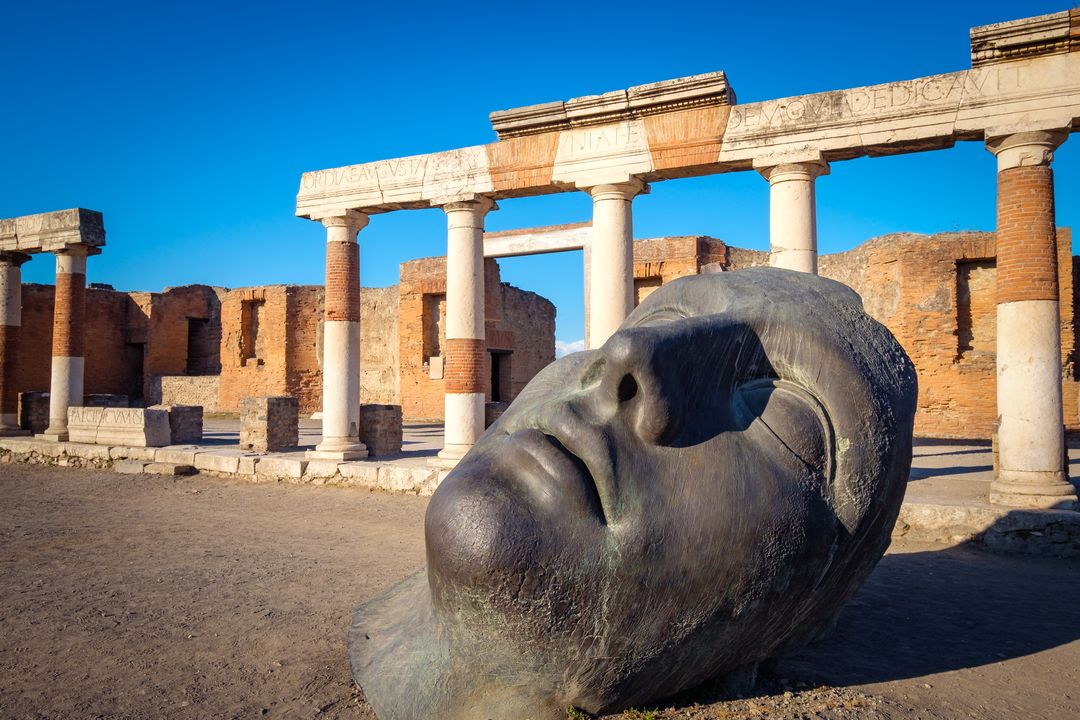


Discover the charm of the ancient city of Pompeii
Explore the charm of the ancient city of Pompeii with a small-group or private tour, an exclusive journey through the city of wonders while strolling with a certified local guide specialized in archaeological excavations.
Pompeii is located on a plateau at about 30 meters above sea level, formed by a Vesuvian lava flow, overlooking the valley of the Sarno River, at the mouth of which stood an active port. The origins of the city are uncertain, and information about them is not clear. The oldest evidence dates back to the late 7th and the first half of the 6th century BC when the first tufa wall, known as ‘pappamonte,’ was built, delimiting an area of 63.5 hectares.
A ‘mixed’ civilization, blending indigenous, Etruscan, and Greek elements, led to the development of the city and the construction of a fortified limestone wall following the Greek system (5th century BC).
Toward the end of the 5th century BC, the Samnite tribes, descending from the mountains of Irpinia and Sannio, spread across the plain of present-day Campania (which means ‘fertile plain’), conquering and incorporating the Vesuvian and coastal cities into a league with Nuceria (Nocera) as its capital.
During the Samnite period, Pompeii experienced a strong impulse toward urbanization: the construction of a new limestone fortification along the Sarno River dates back to the 4th century BC, following a similar path to the previous one.
Toward the end of the 4th century BC, the movements of Samnite populations disrupted the political order, forcing Rome to intervene in southern Italy. Systems of alliances and victorious military campaigns made Rome dominant throughout Campania (343-290 BC).
Pompeii then entered into an alliance within the political organization of the Roman Republic. However, in 90-89 BC, it rebelled along with other Italian populations, demanding equal socio-political status with Rome. Besieged by the forces of Lucius Cornelius Sulla, the city surrendered and became a Roman colony with the name Cornelia Veneria Pompeianorum (80 BC).
After the foundation of the colony, Pompeii was enriched with private and public buildings and further embellished, especially during the age of the emperors Octavian Augustus (27 BC – 14 AD) and Tiberius (14-37 AD). In 62 AD, a violent earthquake struck the entire Vesuvian area. In Pompeii, reconstruction began immediately, but due to the extent of the damage and the seismic activity that followed, it took a long time. 17 years later, on August 24, 79 AD, when the sudden eruption of Mount Vesuvius buried it in ashes and lapilli, Pompeii appeared as a construction site still open. Rediscovery occurred towards the end of the 16th century, but it wasn’t until 1748 that exploration began, under King Charles III of Naples. Systematic exploration continued throughout the nineteenth century, leading up to more recent excavation, restoration, and enhancement efforts focused on the city and its exceptional heritage of architecture, sculptures, paintings, and mosaics. The archaeological area of Pompeii covers approximately 66 hectares, of which about 45 have been excavated.
The division of the city into regiones (districts) and insulae (blocks) was carried out by Giuseppe Fiorelli in 1858, for study and orientation purposes. The names of the houses, when the owner is unknown, were coined by the excavators based on specific findings or other circumstances.